

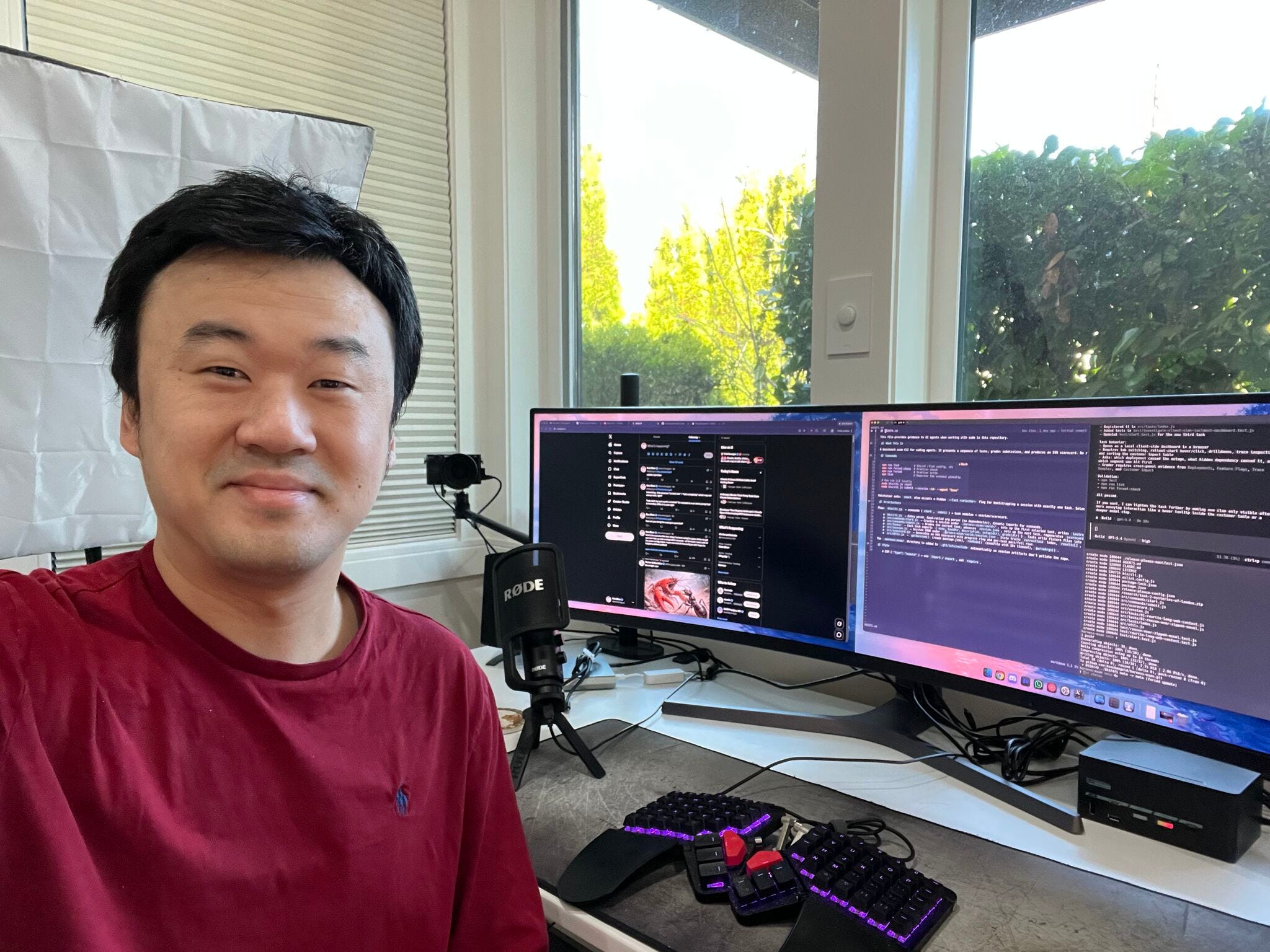
Hi, I'm Kun. I just quit my big tech career as an L8 engineer at Meta, Microsoft and Atlassian a month ago, to be a solo builder.
Throughout my career, I’ve come to know that many ambitious people have all contemplated, or are still contemplating a similar decision -
Continue working for a company, or hop onto an adventure of my own?
So when I left the job, I told myself I will share my journey, in the most transparent and honest way possible, to provide one concrete data point for what a solo builder’s journey may look like.
Now that I’m one month into this - what did I do, what did I learn, and what surprised me?
Why did I leave in the first place?
I’d been working at big companies all my career - Meta, Microsoft, Atlassian - for almost two decades. I had a ton of fun working on products and systems at massive scale - Bing, MSN, Facebook Gaming, and Atlassian’s Rovo Dev agent, to name a few. Compensation has been great, and I learned a lot from many amazing people.
But a few things started changing over the past couple of years -
As I continued to level up in my own career, my time is much better leveraged by teaching/telling other people what to build, rather than building things myself. But I love the process of building, not just the output of it. I kept declining meetings so I had more time to build, but I found myself fighting against gravity.
The advancement in AI has both created massive opportunities for new things to be built, and also made me see how much more one person can achieve now compared to before. I have many ideas piled up over the years that I finally felt I could easily explore by myself for real.
My son is now 8 years old and can beat me in chess. My wife and I both felt our lives are finally “back to normal” and we have some breathing room to think about what we really want to do. We also have some savings to support the family for a while, even if neither of us makes money.
These elements created a perfect condition that pushed me over the edge. I’m going back to the roots where everything began -
A desk, a computer, and a beating heart.
The brutal reality
Still, I have to be honest with you and myself that this was not a fully rational decision.
I tried to model different outcomes of my decision here - I might achieve nothing; I might build something and get acquired; I might self-sustain a bootstrapped business; or in the off chance I might end up building a unicorn.
Even with an unreasonably high amount of optimism assumed, the compensation from big tech always beats the expected return from my own journey. But can we make decisions like this with math?
Looking back at all the important events in my life, absolutely zero of them was made with numbers and equations. Especially the big decisions I didn’t regret, I’ve always made them by following my heart, listening to my inner voice and being who I want to be.
I already knew what I wanted. I just needed to admit and act on it.
By choosing this path, I had to acknowledge that a tradeoff is being made on the financial outcome, and money should not be why I’m doing this. What’s not visible in the math is curiosity, learning and growth - that’s what I’m optimizing for.
What did I do in the first month
The first Monday after leaving my job, I woke up, made coffee, and sat down at my desk. A big question mark popped up -
What do I do now??
The blank canvas
For many years, when I came to my desk in the morning, I have a pile of messages waiting for me to respond to, a full day of meetings to prep for, and an infinite scroll of todo list to pick up from.
Now there’s nothing. A blank canvas. It’s a strange feeling. But I knew that’s the whole point!
The first idea I wanted to do for quite a while is an AI tutor for kids. I have an 8-year old son who’s starting to learn to code, and this would at least help him a lot. I can talk all day about why this is such an interesting area to explore, but that’s probably for another day.
I simply sat down and started building.
The side quests
I’ve been coding for almost 30 years so I’m “old-school” in certain ways, but in the most recent years I’ve been developing agents so I’m also very “AI pilled”. My setup is now a weird combination of classics like tmux, neovim and bleeding edge agent orchestrators. Happy to share that another time as well.
Building solo vs building with a team turned out to be quite different. I experienced many pain points in the agentic part of the workflow that the state-of-the-art tooling couldn’t address well. So I also started building tools to make my workflow more efficient. This resulted in me publishing quite a few open source projects -
“good night have fun” - https://github.com/kunchenguid/gnhf
“git push no-mistakes” - https://github.com/kunchenguid/no-mistakes
“treehouse” - https://github.com/kunchenguid/treehouse
As these projects started to be used by more and more people, I found myself becoming an open source maintainer. Every day there are some bug reports, feature ideas, and PRs to review. I also experienced pain points in this process, and started building tools to make open source maintenance easier as well.
So my footprint organically went from just the AI tutor idea to now a portfolio of projects. You might call them side quests, but I started doing them because I saw a cohesive theme, which I’ll cover in a few sections.
Beast mode
I’m constantly thinking, building, and shipping. Yesterday, I shipped 32 new features and improvements across the projects - all well tested and documented - and it was one of the slower days.
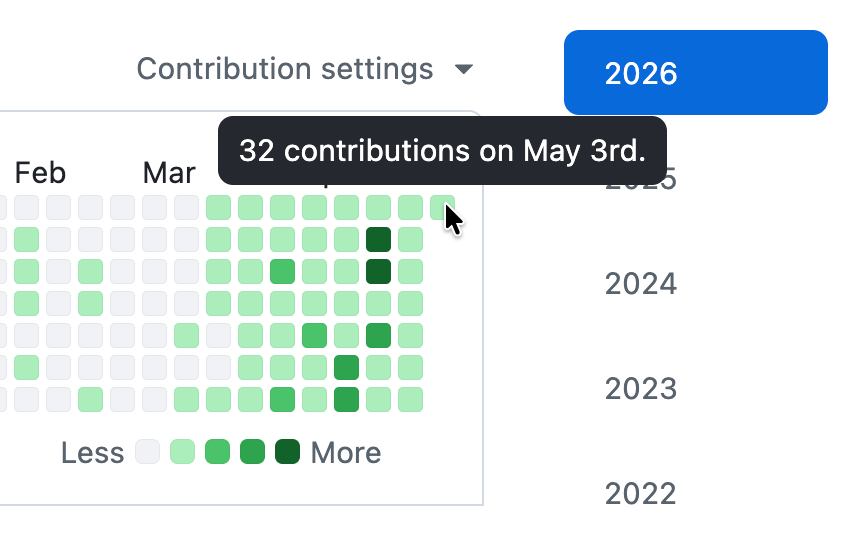
I’m in a constant flow of ideas. The speed and quality of my thoughts is the only bottleneck. No stakeholder alignment. No kickoff meetings. No compromises.
I get an idea, 15 minutes later it’s live and some people already started using it. People came into my discord reporting bugs, by the time they finished explaining what the bug was, it’s already fixed and released.
This felt GREAT. I don’t know how else to articulate it except for using bold + italic + all caps all at once. It’s not just great - it’s GREAT.
Except it doesn’t make any money. Of course it’s all fun and games when there’s no real business. So am I making meaningful progress?
The unexpected momentum
I would not have believed it a month ago if you told me I will have -
Almost 0 to 7k+ followers on X within 7 days, many of whom I now often have interesting conversations with
gnhf - an open source tool I built mostly for myself would cross 1000 stars on GitHub organically
14k+ views on my podcast with Steve Huynh and counting (though that’s mostly Steve Huynh’s popularity :))
I’m extremely grateful to see so many people supportive and interested in my journey of going solo. I think when I look back on this, interacting with this community of builders is probably one of the most meaningful activities I’d be doing.
These are not massive numbers by any means, but I definitely felt pleasantly surprised as someone who’s never done any of this before. So I reflected on what allowed me to create the momentum, beyond being incredibly lucky.
I mostly boiled it down to 3 things.
1. Show up as an authentic human
My first viral tweet was the AMA I posted when I quit my job. I had very few followers back then - mostly colleagues over the years. Whenever I tweeted, it was usually a silent scream into the void.
I expected the AMA to maybe get 5-10 questions in total, mostly asking why I left and what I’ll do next. As it turned out, this tweet got 200k+ views and it became a very busy day responding to 300+ interesting questions from people all over the world.

Different from my usual tweets of random opinions, the biggest difference this time was that I showed up as a real human being sharing my real experience.
In the age of AI, there’s an increasing amount of people who create slop content for engagement. I think it made authenticity more important than ever, and this is something I’ll always stick with.
2. Craftsmanship and taste
My first popular open source project gnhf was a tool that can help you keep agents running for a long time.
I could have named it something like “long running agent orchestrator”, and its core functionality could have been done as a simple CLI command. But this time since I’m a solo builder, why not add some personality to it?
I ended up spending quite some time thinking hard about how I could make that happen. I realized I often use it to get work done overnight, so picking a name that would reflect this use case might help people more easily get what it does. And if I name it after a night time scenario, I might as well make it look like that as well.
So that chain of thought led to me building it as “good night have fun” - a TUI that renders a starry night and gives you a feeling of zen while your agents are busy doing all the work behind the scenes.
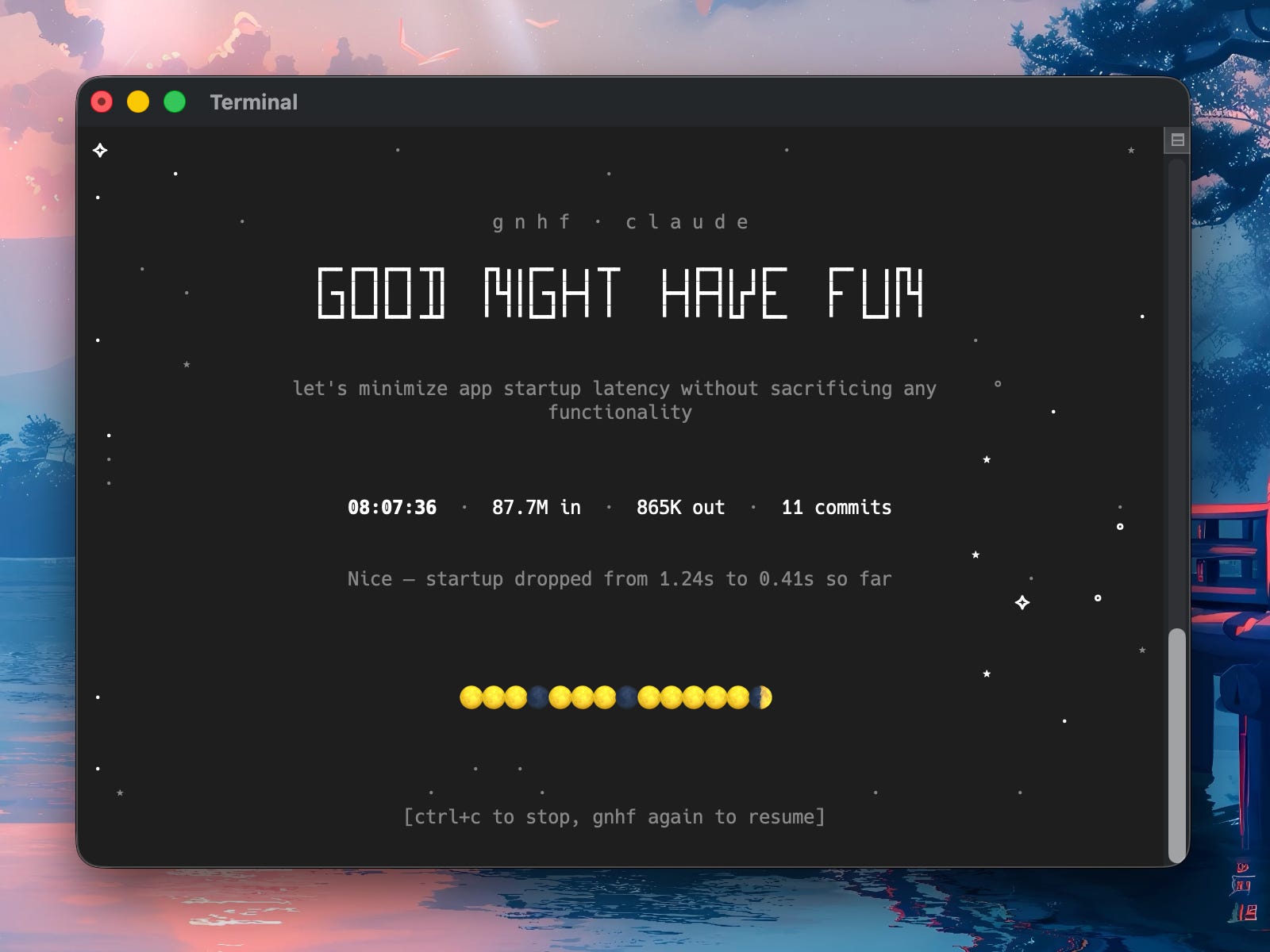
Looking back, I believe this made quite a difference. Many people who reached out to me about this project brought up the UI being something that grabbed their attention.
3. Make connections
The way I got to know Steve Huynh was when I made a few YouTube videos talking about software engineering career a few years ago.
It was purely a hobby and I expected nothing out of it. I certainly didn’t expect one day I’ll get a message from Steve to discuss collaboration ideas. I most definitely didn’t expect that a few years later when I quit my job I’ll get support from Steve and through him get to know other talented, like-minded builders and creators.
I have to admit I’m a textbook introvert, and networking is not my thing at all - if you leave me alone, I will actually be alone.
But over the years, experiences like this made me value connections more and more. Especially out here as solo builders - it’s everyone helping each other.
Let’s talk about autonomy
The autonomy of being solo is unbeatable.
Putting aside big companies, even being a new startup with a co-founder or a small founding team would be nowhere close to what I have today.
If I want, I can pivot my strategy 5 times a week. I can tell myself on Monday I have a brilliant idea and on Tuesday I say it’s total crap without being judged or losing credibility. I can decide to do no work today and spend 8 hours on this blog post that I suddenly felt the urge to write.
There’s no one else to convince.
Is that good or bad? I see it as a double-edged sword.
On one hand, the ability to make decisions and jump onto new opportunities extremely quickly is a massive advantage against bigger companies. By the time they booked a meeting with enough stakeholders, I could have already shipped every version of what they are about to discuss.
But on the other hand, I can easily randomize myself. New things come up every day, and there’s an endless number of different things I could be doing at any given point in time. Without any accountability, I may end up losing focus and it’s death-by-thousand-cuts.
So how to deal with that? Maybe my experience as an L8 is useful after all - I know the answer. I know how to avoid distractions and keep focus. It’s the same for a company, a team or an individual -
Be clear about the mission
As a solo builder, I realized it’s important to have a personal mission. If I have 10 ideas that would give equal financial outcome, which one would I choose to work on, and why?
Answering this requires a surprisingly deep understanding about ourselves. I spent quite some time questioning myself whether I’ll be truly satisfied if I look back and say “this is how I spent my life” - so many things got filtered out during this exercise.
What I ended up defining as my personal mission is -
I want to empower every individual to discover, pursue and achieve their full potential.
I believe there are many individuals who have great ambition, but may not have the right education, support and resources to go after it. And I think I can help by strengthening the solo builder community and building the right technology to give everyone the leverage they need to pursue their dreams.
Before I spend time on a new idea, I can now question myself - is that an impactful thing that’ll help advance that mission?
If the answer is no, don’t do it. It’s that simple.
Looking forward
I honestly don’t know what the next couple of months will look like yet, just like I couldn’t have predicted where I would be at the end of this first month. The “not knowing where it takes me” was part of the point, so I’m going to continue going with the flow.
The AI tutor is a main quest. It aligns very well with my mission, and frankly ever since I gave the prototype to my son, he kept asking for bug fixes and features that I couldn’t stop now even if I wanted to. I will definitely share more about this soon.
I also wanted to carve out more time to share my experience. I will be writing on my Substack here on what I’m learning as a solo builder, so don’t forget to subscribe if you are interested in more pieces like this.
I will also restart my YouTube channel and record some content that’s best delivered as videos, such as sharing my workflows and tools. And my X account will continue to be where I post latest unhinged thoughts.
Thanks for reading. Until next time!
Thank you for sharing this, Kun. I recently came across your YouTube channel and this article, and both really resonated with me.
I especially liked the harness you built around your own development workflow. It was inspiring to see how intentionally you are shaping your environment and tools around the way you want to work and think.
A lot of what you wrote about “what comes next” felt very familiar to me. My son recently turned 13, and I often find myself frustrated by how much of his time and attention gets pulled into his phone, laptop, YouTube Shorts, TikTok, and endless short-form content. Kids today are growing up in a world where these things feel almost impossible to avoid.
At the same time, I keep thinking there must be a better way. I have a similar idea of building something that helps kids not just “use AI,” but actually master AI as a learning tool — something that encourages curiosity, critical thinking, and real understanding, rather than simply giving them easy answers or finished solutions.
I admire what you’re doing in many ways. Part of me would love to take a similar leap and fully pursue something meaningful like this. But realistically, I don’t have that luxury right now from a financial perspective. I still have bills, a mortgage, and family responsibilities to take care of.
Still, your story is very motivating. It reminds me that even if I can’t make the same leap right away, I can still start building, experimenting, and moving in that direction step by step.
Thank you again for sharing your journey so openly. It gave me a lot to think about. Wish you all the best, and cheers!
> The first Monday after leaving my job, I woke up, made coffee, and sat down at my desk. A big question mark popped up - What do I do now??
It's very mind blowing and bold. To decide to pursue yourself, but not having an actionable plan.
Often times, we hear a bunch of success stories, telling us that no one believed in them and their ideas. And clearly, given its a success story, the naysayers were wrong. But on the flip side, there are actually many times where people sincerely have a bad idea and the markets are accurately conveying to them its a bad idea.
I've always wondered, how do you draw that line. How do you rationalize whether you're ideas are good and people haven't caught up? versus your ideas are bad and the markets reaction makes sense.
Curious how you think about that